
Home / VR, AR & digital twin overview
VR · AR · Digital twin
VR training for industry
New employees learn faster when they can practise. With a VR simulator based on a digital twin of your production line, operators train machine operation, changeovers and safety procedures as often as they need – without stopping production and without risk for people or equipment.
Reply within one business day · EN · DE · PL
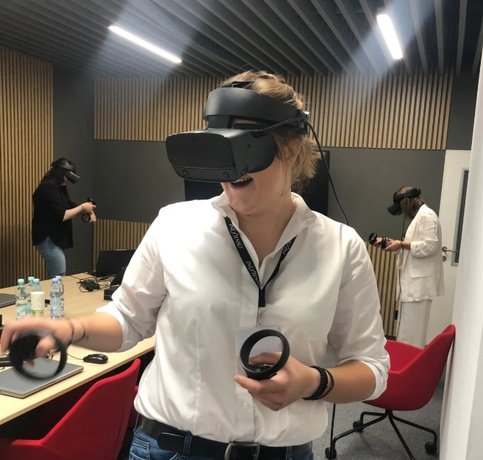
Real project · aviation & MRO
Watch: VR run-up simulator in action
Boeing 737 engine run-up training in virtual reality – a real project with measurable results. 4-minute video.

What you can train in VR
- Onboarding of new employees
- Operation of complex machinery
- Changeovers and maintenance procedures
- Health & safety and accident scenarios
- Testing new parameters and layouts
- Training of entire teams regardless of location
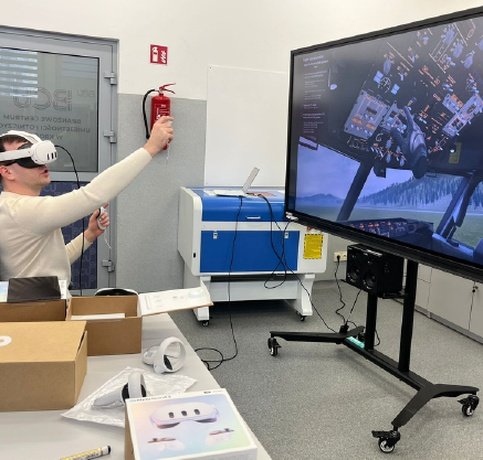
Why VR works in manufacturing
In VR, trainees act instead of watching. They repeat procedures until they are confident, make mistakes without consequences and build muscle memory. Instructors receive objective reports on errors, time and completed steps. Dangerous situations – such as accidents or malfunctions – can be trained safely.
Ready for your plant
We build the simulator from your CAD data, 3D scans, photos and the know-how of your experts. The result can run on standalone VR headsets, so training can take place in a meeting room, a training centre or directly at the line.
How we work
Step by step
Kick-off workshop and choice of procedures
Design: scenarios, UI and training modes
Production: 3D models, programming, sound
Testing with your experts
Implementation, training and support
Proven results in VR training
In a VR run-up simulator for aviation mechanics, procedural accuracy in the first attempt increased by 65%, errors were detected 2.8× faster and knowledge retention after three months reached 75% – see our case study.
All case studies →Selected clients of our partner network

FAQ
Frequently asked questions
How long does it take to build a VR training?
A first MVP can be ready within weeks; complete simulators typically take a few months, depending on the number of scenarios.
Which hardware is needed?
Standard standalone VR headsets are sufficient for most applications. We advise on the right hardware.
Can several people train together?
Yes, multi-user training is possible, for example for team procedures.
Let’s talk about your training challenge
Describe your use case, the number of users and your timeline. We will get back to you with a concept and a budget range.
Thank you – your enquiry has been sent.
We will get back to you within one business day.